

The Lettering Pass
Nuts and bolts of comic writing: The lettering! Who does what and why?

Hey, Comic Book Writer! What about the letters in the balloons?
So, I recently stumbled across a typically pointless online debate, between a well established letterer and some random commenter somewhere. I say pointless because there’s no reason to engage in these discussions, which end up eating mental space and frustrating you, when the reality is the conversation is generally only going to be seen by a handful of people. Worst case scenario, one of the social media dwelling comics “news” sites will find it, amplify it, and then it’s out of your hands. (which happened)
In any event, this debate started with a commenter blaming “the letterer” for misspelled words in a comic book he’d read. The well-established letterer then jumped in and pointed out that it’s not a letterer’s job to spellcheck a script. More often than not, the letterer is cutting and pasting from the script handed to them by an editor, and by that point the letterer generally expects writer and editor to have corrected anything they wanted corrected. Of course, the original commenter argued with the well-established professional letterer about how the well-established professional letterer’s job works, because when you’re debating online, you’re not allowed to admit you don’t know what the hell you’re talking about, and you laugh at the idea that someone knows how their actual job works better than you do.
But I digress.
Essentially, the letterer was right. In a typical writer/editor/letterer relationship, there are enough fail safes in place to catch any misspellings or accidentally jumbled syntax.
Having said that, mistakes still slip through. Sometimes a thing will slip past all precautions, and when a book hits the stands, you’ll realize a character is using the wrong name, or “monster” might be spelled “mnster.”
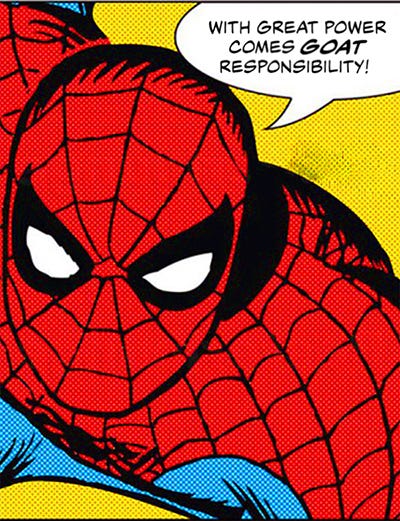
And, as a writer, that stuff never stops bothering you. You assume readers will think you’re the one who fucked up, despite your full confidence that you can spell “monster” correctly.
Shut up. What’s your point?
Since one of the stated goals of this newsletter was to provide advice and perspective from my years in this business, I thought I’d detail how the lettering process normally works.
Typically, this is the process when working with an editor and a letterer who is working with the publisher (in some creator-owned books, you might not have an editor, and you or the artist might even be lettering the book yourselves). I’m going to break it down very clearly:
THE LETTERING PROCESS
Step One: The writer turns in a finished script, complete with dialogue attached to each panel description. The writer then considers a shower, but realizes he took one last week, and opts for a nap instead.
Step Two: The editor reviews the script, and passes any notes back to the writer. Personally, I hope those notes are in a separate email, and not in some edited document, because my brain gets confused by things like Markup. Also, I hope there aren’t any notes, because I am a genius who doesn’t need to be second guessed. I kid, I kid! The truth is my particular brand of brain suffers from ADD, and I have a very hard time doing a lot of revisions on a thing that’s already finished with a set page count.
Step Three: The writer reviews the notes, snorts, flips off their computer, stomps away, has a drink. Then calms down, reviews the notes again and realizes some of them make sense.
Step Four: The writer turns in the revised script.
Step Five: The artist gets the script and is forced to climb off their luxury yacht and return to the drawing table, where they then, you know … draw the comic book.
Step Six: Sometimes the artist will turn in breakdowns (rough layouts) for the story for approval from the editor and writer (artists are so needy). Once their scribbles have been approved, they then REALLY draw the comic book.
Step Seven: This is probably the most important step, to be honest. Ideally the editor will send the finished art back to the writer, who will then compare it with the script, and make any changes they feel are warranted to better work with the art, or even just to address any niggling concerns. (no one wants a concern to niggle)
Step Eight: The finished art and script will then go to the letterer. As indicated above, the letterer will generally cut and paste directly from the document, converting the lettering into whatever font they’re using and to whatever font size they’re using, in whatever program they’re using. (Adobe Illustrator, say)
Step Nine: The lettered pages will then go back to editorial, and editorial will make any notes. (maybe balloon placement is an issue, or a balloon tail is pointing to the wrong character, or the letterer accidently cut and pasted a script for SPIDER-WOLVERINE EATS PUNISHERPOOL’S BRAIN into the story instead of using your script) The editor will then generally send it back to the writer to check one more time for any desired changes. (changes related to the story, not to your miserable deskbound lifestyle, lowly scribe)
Step Ten: Notes bounce back to the letterer, who addresses those notes (one hopes), and then the issue should be all done and ready for print. (depending on where the colorist is in the process, but this about lettering, not those artistes and their digital pallets)
And that’s about it!
Sometimes, there may be a separate proofreader involved to provide a fresh set of eyes, which I suppose takes some of the burden off of already overburdened editors. Any notes there are generally rolled in with the editor’s notes. Which, I will say, isn’t always ideal, because if a wonky note comes back from the proofreader, it helps to know it isn’t from your editor having a stroke.

How It Should Never Work
The only thing that drives writers (this writer, anyway) crazy is when editorial changes dialogue without asking the writer (this writer, anyway) to make the changes themselves. It can also drive writers (this writer, anyway) crazy if an editor adds or subtracts dialogue without telling them.
In fact, any changes to a script should always be run past the writer before they’re made. And if editorial has a particular problem with a scene, they should always address it with the writer, giving them a chance to either argue their case or make the changes themselves.
Surely this goes without saying, right?
Well, evidently not. Without naming names, I once had editorial rework an opening scene to the opening issue of a series without informing me or asking me to change it. And the reasons they had for changing it, were, to be frank, completely wrong. Insanely, illogically wrong. And the changes that were made completely neutered the scene, since what they removed was the key character moment to open the book. Even had they (wrongly) forced me to change the key moment, they should have given me a chance to rework the scene instead of crush the scene with a lame edit. So there.
Along those lines, in the same series, I once received the art and was asked to do the usual lettering pass, working off of my script and the art, obviously. The problem was, I realized after looking over the art, that I hadn’t written one of the key scenes in the book. In other words, an editor had decided to rewrite the scene, including a change of locale, without consulting me or even asking me about it. When I inquired as to what had happened to the story I’d written, the editor did explain to me why they had decided to make the changes. Which doesn’t excuse it, since the story went out with my name on it as the writer.
I also once wrote a story where an editor changed one word in the script, for some reason changing a character’s reaction from whatever I had written to “Well, isn’t that just ducky.” The word I had not used, in case you couldn’t guess, was ducky. Of course I noticed it when I read the book, because — what? Who says that? Certainly not uber tough paramilitary types. Maybe I was overly sensitive, but I then read a review of the issue, and the reviewer was complimentary of the story, with the only negative note being that the phrase “Well, isn’t that just ducky” seemed out of character. I am not making that up. I was so annoyed, I actually emailed the reviewer to let them know I hadn’t written the one line they singled out. The reviewer responded that they had assumed I was a better writer than that.
This was literally twenty years ago. I guess writers (this writer, anyway) sure can carry a grudge, can’t they?
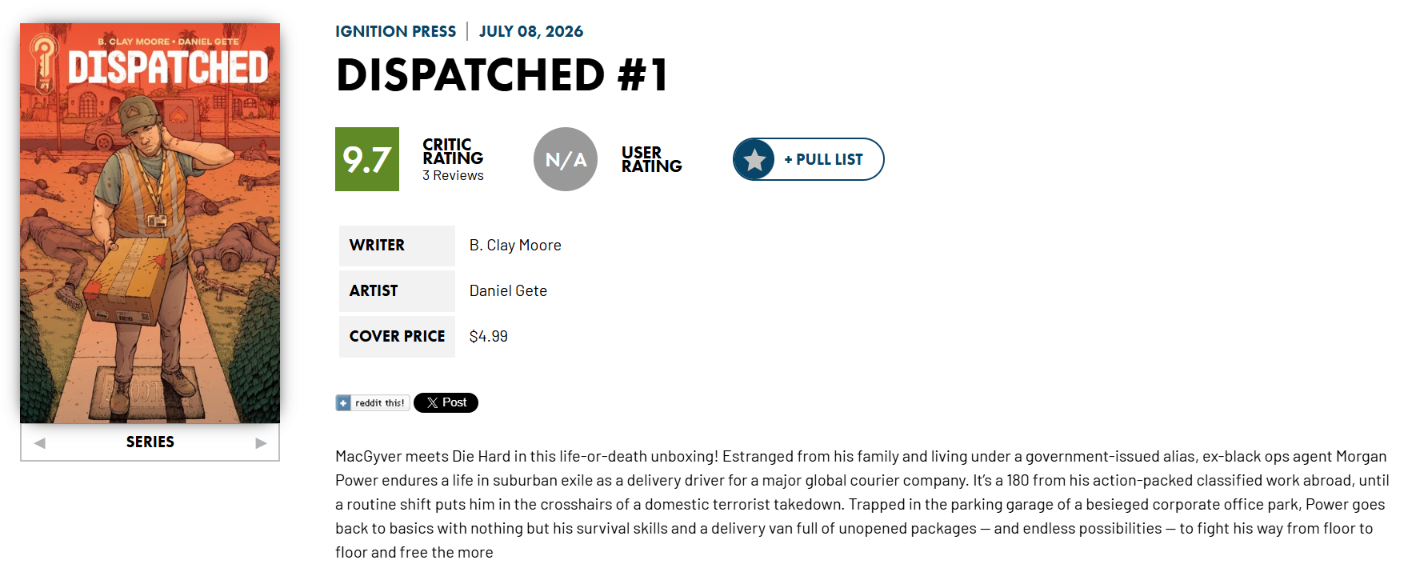
DISPATCHED DAY IS UPON US!
If you’re reading this on Wednesday, July 8th, it’s the day DISPATCHED #1 drops at comic shops all across the globe! If you’re reading this after July 8th, it’s the day DISPATCHED #1 can still be purchased at comic shops all across the globe!
DISPATCHED #1 was written by me, with art by Daniel Gete, color by Lee Loughridge, and letters by Andworld Design.
I’ve only seen a couple of reviews, but they were glowing, which is always a nice thing to see. DISPATCHED is from Ignition Press, naturally (on the even of their first anniversary!) Stop reading this and go grab a copy.
Until next time! -
BCM